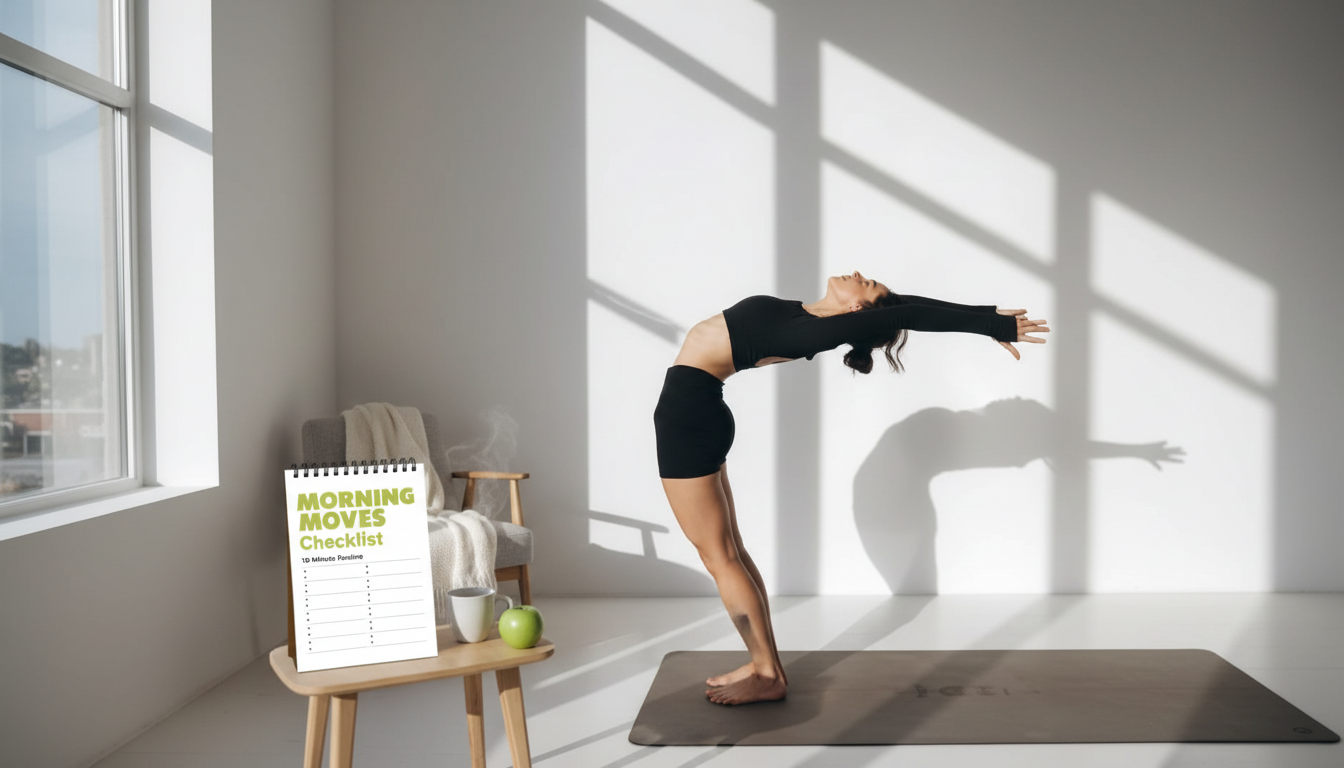
A focused morning doesn’t require a perfect schedule or a long workout. A short, repeatable sequence—hydration, gentle mobility, a quick pulse-raiser, and a short reset—can shift energy, reduce mental fog, and make it easier to start the day on purpose. This checklist-style routine is designed to be printed or saved on a phone, used in small spaces, and repeated daily without overthinking.
A “morning moves” routine is a quick sequence that wakes up the body, increases circulation, and gives your brain a clear starting cue—so focus is less about willpower and more about a reliable pattern. Think of it as flipping the “on” switch: you’re not trying to max out effort; you’re trying to build momentum.
It isn’t a full workout plan, and it doesn’t need to leave you sweaty or sore. Intensity stays moderate and adjustable: you can scale the range of motion, slow the tempo, or pick lower-impact options depending on how you slept and what your day looks like.
The secret is consistency. When the steps stay the same each morning, decision fatigue drops—no negotiating, no scrolling for a routine, no wondering what to do next. It’s also designed for small spaces and minimal equipment (a wall or counter works fine).
For best results, pair it with a simple “start line” habit—like taking a sip of water, opening a curtain for light, or pressing play on the same timer sound—so the routine begins before the brain starts debating.
Set a 10-minute timer and move through the list in order. The sequence matters: you’re going from “wake up” to “warm up” to “steady focus,” without spiking stress or overthinking form.
Take a few sips of water, stand tall (soft knees, shoulders down), and take slow nasal breaths. This is your signal that the day has started.
Use gentle circles and twists to loosen common “sleep stiffness” areas: neck circles, shoulder rolls, thoracic twists, and hip circles. Keep it smooth—no forcing range.
Pick 2–3 bodyweight moves to switch on glutes, core, and upper body: glute bridges, bodyweight squats, incline push-ups on a counter, or dead bugs. Aim for controlled reps, not speed.
Choose low-impact movement that raises your heart rate without pounding: marching in place, step jacks, brisk stair steps, or a short indoor walk loop.
Do a single-leg stand, heel-to-toe walk, or a plank variation. Balance work subtly demands attention, which can help “pull” the mind into the present.
Finish with one breathing method and keep it consistent day to day. Box breathing (inhale/hold/exhale/hold) or 4–7–8 breathing both work—pick one and repeat daily.
| Time | Move | Goal | Easy Option | More Challenge |
|---|---|---|---|---|
| 0:00–1:00 | Hydrate + tall posture breaths | Wake up + steady breathing | Sip water, 5 slow breaths | Add gentle standing reach |
| 1:00–3:00 | Mobility flow | Loosen joints + spine | Smaller ranges of motion | Deeper twists, slower control |
| 3:00–6:00 | Activation circuit | Turn on glutes/core/upper body | Wall push-ups, chair squats | Tempo squats, full push-ups |
| 6:00–8:00 | Light cardio | Increase circulation + alertness | March in place | Step jacks or faster steps |
| 8:00–9:00 | Balance + core | Stability + attention | Two-foot stance, light support | Single-leg hold, longer plank |
| 9:00–10:00 | Breathing reset | Shift into calm focus | Box breathing (4-4-4-4) | Longer exhales (inhale 4, exhale 6–8) |
Light daily movement supports overall health and energy; the Physical Activity Guidelines for Americans (2nd edition) outline how regular activity contributes to well-being over time. Hydration needs vary, but a practical starting point is to drink water early; the Mayo Clinic’s overview on daily water intake explains factors that change your needs. And when stress is high, short downshifts can matter—here’s the American Psychological Association’s summary of stress effects on the body for context on why calming practices can help.
Yes, especially when it’s consistent. Light movement can increase alertness and reduce mental fog, and repeating the same sequence daily builds a reliable “start” cue without needing high motivation.
Use a 3–4 minute minimum: 2 minutes of mobility, 1 minute of brisk marching, and 1 minute of breathing. Keep the same order so your brain still recognizes the routine as the start of the day.
No—everything can be done with bodyweight and a wall or counter. A yoga mat or light resistance band can be optional, but the checklist is designed to work anywhere with just a timer.




Leave a comment
You must be logged in to post a comment.