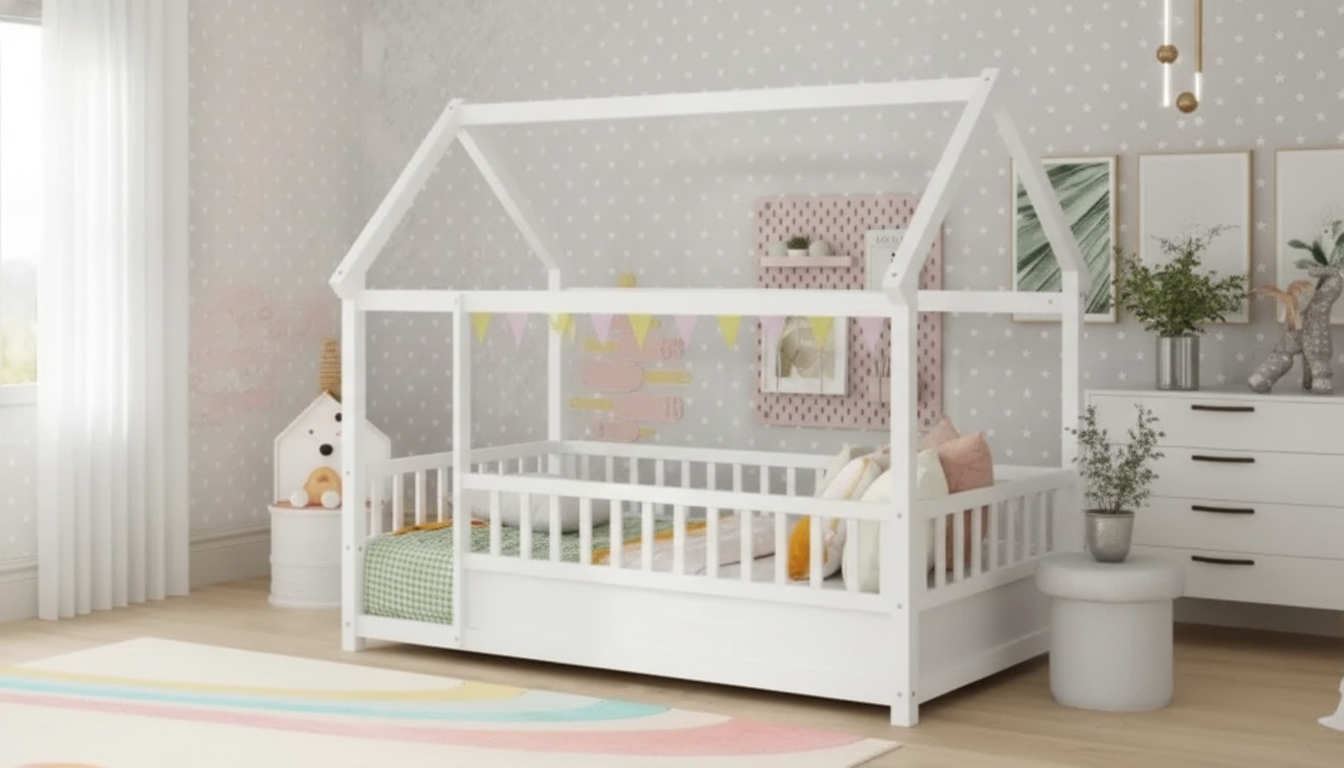
A Montessori-style floor bed with a fence supports independence while helping create clear boundaries for sleep and quiet time. This guide covers what a fenced floor bed is, how it supports early childhood routines, what to look for before buying, and how to set it up safely and comfortably in a toddler bedroom.
A Montessori floor bed with a fence is a low-to-the-ground bed frame designed so a toddler can climb in and out without being lifted. Instead of tall crib walls, the sleeping surface stays close to the floor, helping reduce the impact of small tumbles while encouraging self-directed movement.
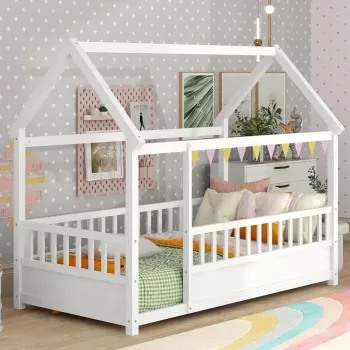
The “fence” is a surrounding rail system—often with an opening—that creates a defined sleep zone. For many children, that boundary feels cozy and helps limit rolling out during the night. It’s commonly used as a bridge between crib life and a standard bed, offering more freedom while still feeling contained.
These beds work best with a firm, properly sized mattress and a simplified bedroom layout. The goal is a child-ready room where the bed is just one safe, accessible part of an environment a toddler can navigate.
Many families choose a fenced floor bed because it combines two needs that can feel at odds: freedom and structure. A toddler can decide when to lie down, sit up, or get out of bed—without waiting for an adult—while the fence still communicates, “This is your sleep space.”
For families who prefer calm bedtime rhythms, the combination of a low profile and a clear boundary can make the sleep environment feel more consistent from night to night.
A floor bed changes the way a child interacts with their room—because once they can get out of bed, they can reach more of the environment. Before switching, focus on room readiness as much as the bed itself. For broader guidance, review the American Academy of Pediatrics safe sleep recommendations and consumer safety guidance such as the CPSC crib safety tips (many principles—like avoiding hazards and ensuring sturdy assembly—still apply during transitions).
| Feature | What to look for | Why it matters |
|---|---|---|
| Fence rails | Safe spacing, smooth edges | Reduces risk of bumps and unsafe gaps |
| Door/opening | Wide, easy entry | Supports independent in/out movement |
| Low profile | Near-floor sleeping surface | Minimizes injury risk from falls |
| Support system | Sturdy slats/platform | Keeps mattress stable and supported |
| Finish | Child-safe, low-odor | Helps maintain indoor air comfort |
If you want extra softness underfoot (especially for early-morning wakeups), a plush rug like the Soft Velvet Plush Blue Rug for Living Room & Bedroom – Modern Fluffy Carpet can add comfort while still keeping the room feeling simple.
| Item | Details |
|---|---|
| Product | Montessori Floor Bed with Fence |
| Price | 325.51 USD |
| Availability | In stock |
| Best for | Toddlers and young children who benefit from a low sleep surface with a defined boundary |
Many families consider the switch after the crib stage, often sometime in the toddler years, but readiness matters more than a specific age. Look for steady mobility, the ability to follow basic bedtime expectations, and a fully childproofed room.
A fence can help reduce rolling out and provide a clear boundary, which may improve settling for some toddlers. Safety still depends on correct assembly, safe rail spacing, a firm mattress that fits well without gaps, and a room that’s thoroughly childproofed.
A firm mattress sized to the frame is typically the best choice, with minimal space between the mattress edge and the rails. Follow the bed manufacturer’s sizing guidance and aim for a setup that stays clean and allows the mattress to breathe.



Leave a comment
You must be logged in to post a comment.