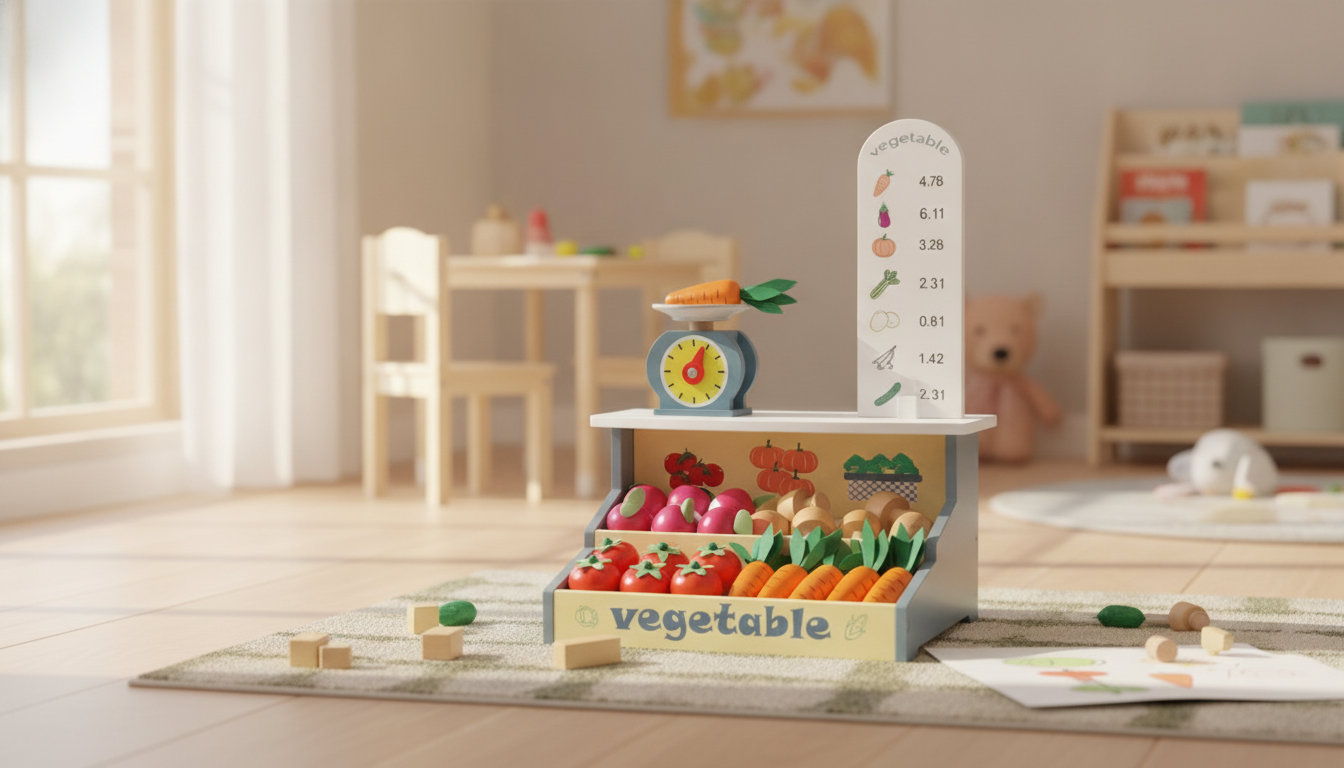
A wooden market stand with a colorful set of veggies turns pretend shopping into hands-on learning. This playset supports imaginative role-play, early counting and sorting, and everyday “market” routines kids love to copy—stocking shelves, taking turns at checkout, and packing a basket for a make-believe dinner.
If you’re building a play space that gets used day after day, a stand-and-produce set is a smart choice: it creates a clear “place” for play, keeps pieces visible, and makes it easy for kids to start a game on their own without a lot of adult setup.
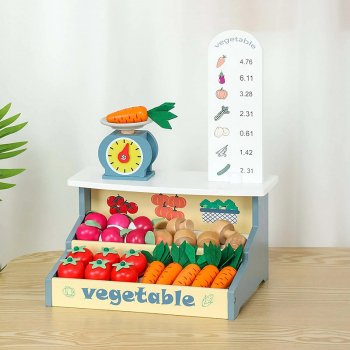
The Wooden Vegetable Market Playset with 24 Veggies & Market Stand is designed to feel like a mini produce stall. Kids can display veggies, “sell” them to customers, and build little routines around shopping and cooking.
| Item | What it adds to play |
|---|---|
| Market stand | Creates a dedicated role-play space and encourages organizing and cleanup routines |
| 24 wooden veggies | Supports sorting by color/type, counting, and pretend cooking |
| Wood construction | Sturdy feel for frequent play and a classic look that fits playrooms |
| Pretend market theme | Encourages social interaction, turn-taking, and simple “money” or “trade” games |
Loose play food is fun, but it often ends up scattered—then the game ends early. A stand changes the flow by giving kids a “stage” for their ideas, which helps play last longer and restart faster.
For families with multiple kids, the stand also reduces conflict: there’s a natural “counter” boundary, and there are plenty of roles to rotate through without anyone feeling left out.
Pretend market play can quietly support school-ready skills while still feeling like pure fun.
Many families also use market play to encourage real-life food curiosity—naming veggies, talking about meals, and making the idea of “trying something new” feel familiar.
A single playset can meet kids where they are. The key is to keep the “rules” simple and change the challenge level, not the toy.
For deeper guidance on toy safety, consult trusted references like the U.S. Consumer Product Safety Commission toy safety guidance and the American Academy of Pediatrics tips on choosing appropriate toys.
If the play area is on a hard floor, adding a soft surface can make longer play sessions more comfortable. A washable option like the Botanical Floral Non-Slip Area Rug – Soft, Modern & Machine Washable can help define a “market zone” while making it easier to sit and sort pieces.
If you want a cozy corner for pretend play (and a soft landing for knees during checkout), the Soft Velvet Plush Blue Rug for Living Room & Bedroom – Modern Fluffy Carpet can help turn an open area into a dedicated play spot.
| Detail | Value |
|---|---|
| Product page | https://elevatdlife.com/wooden-vegetable-market-playset-with-24-veggies-market-stand/ |
| Price | 28.51 USD |
| Stock status | In stock |
Many kids enjoy this style of play from toddler years through early elementary, with activities changing as they grow (color matching for younger kids, checkout math for older kids). Follow the toy’s recommended age and supervise younger children, especially if any pieces could be a choking hazard.
Wipe pieces with a slightly damp cloth and use mild soap only if needed; avoid soaking the wood. Dry everything fully before storing, and regularly check for chips, cracks, or splinters.
Pretend shopping supports counting, sorting, and vocabulary while kids practice turn-taking and polite conversation. Adding simple prices and a “checkout” routine can also introduce early addition and money concepts in a playful way.


Leave a comment
You must be logged in to post a comment.