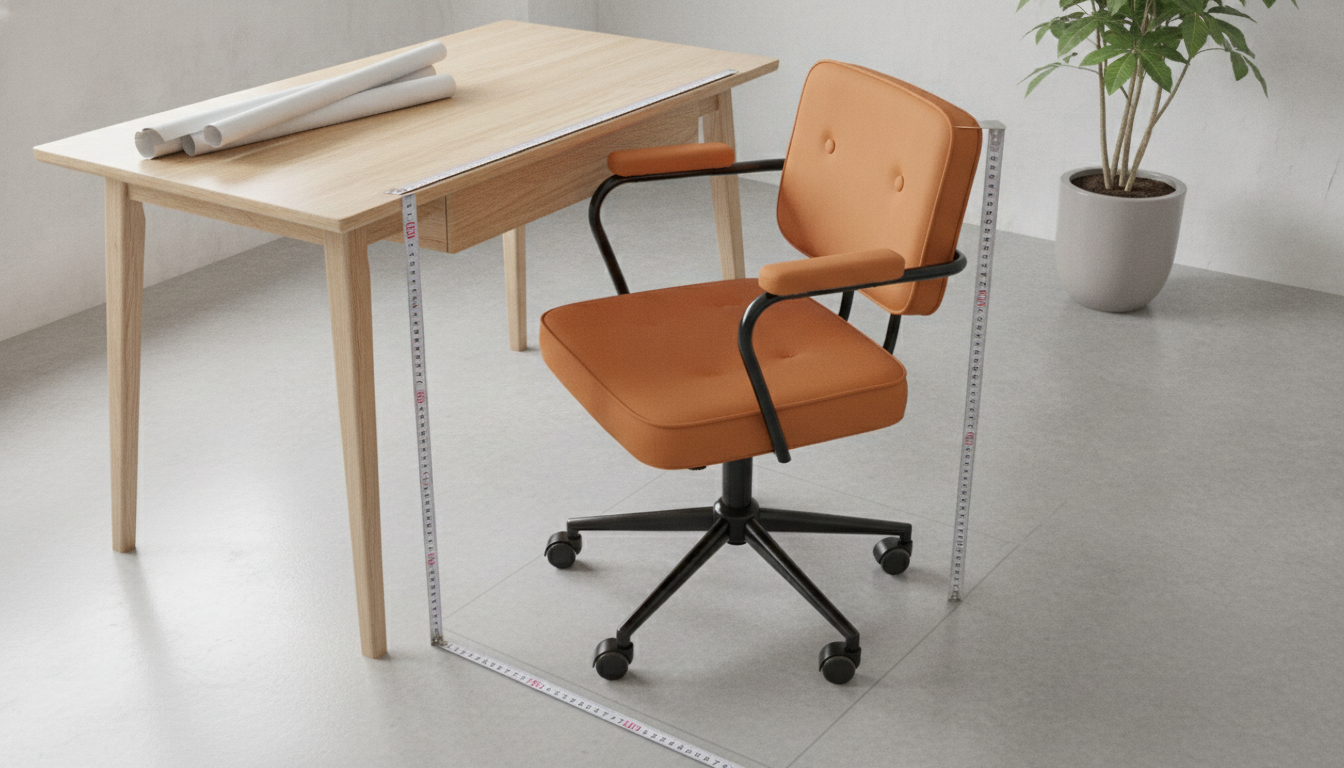
To make sure a compact swivel office chair actually tucks under your desk (instead of bumping the underside or getting stuck on armrests), measure three things: the desk’s clearance height, the available knee space width, and the depth you can slide the chair in.
Use a tape measure from the floor to the lowest point under the desk where the chair must pass—this is often the apron, support bar, drawer bottom, or keyboard tray. Write down that number as your maximum chair height while stored. If your chair has armrests, compare this clearance to the chair’s arm height (floor to top of armrest) at the chair’s lowest seat setting.
Measure the left-to-right space between any desk legs, cabinets, or drawer units where the chair needs to slide in. This is your maximum chair width. If the chair has fixed arms, use the chair’s overall width (arm-to-arm). If arms are adjustable or flip-up, confirm the width in the position you’ll store it.
Measure from the front edge of the desk (or keyboard tray) back to any obstruction like a crossbar, wall, or power strip. Compare that to the chair’s seat depth and overall depth (including the backrest if it reclines or tilts). If space is tight, plan on leaving a couple inches so casters don’t jam against the wall.
Thick carpets, chair mats, and soft casters can change height slightly. Also check whether armrests can slide under the desktop when the chair swivels; a chair that fits straight-in may still catch when angled.
For chair dimensions to compare against your measurements, see the sizing tips and compact options in this guide to compact swivel office chairs with armrests for small spaces.
Focus on overall width (especially arm-to-arm), arm height from the floor, and overall depth when the backrest is upright. Those three measurements most often determine whether a chair fits between desk supports and slides in neatly.



Leave a comment
You must be logged in to post a comment.