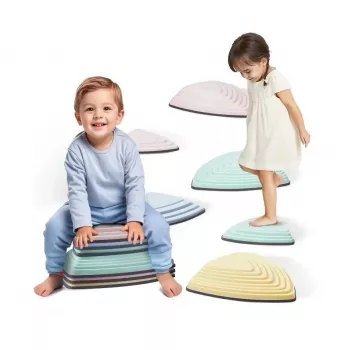
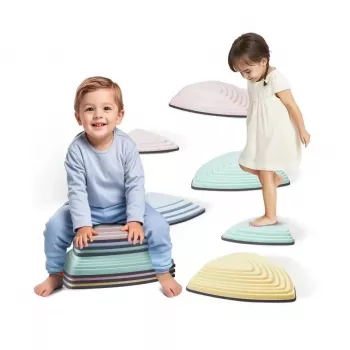
Balance stepping stones turn ordinary floors into an obstacle course that encourages kids to jump, step, pause, and plan their next move. This 6-piece set supports active play that builds coordination and body awareness while keeping setup simple for homes, classrooms, and therapy spaces. When kids get frequent chances to practice controlled movement, they’re also building habits that support daily physical activity—something encouraged by organizations like the CDC and the American Academy of Pediatrics.
Stepping stone play looks simple, but it naturally targets foundational movement skills. With repeated “try again” moments, kids learn to adjust their bodies without needing a formal drill.
For many kids, the biggest win is learning how to pause, reset, and continue—skills that carry over to playground games, sports basics, and everyday transitions like stairs or hopping over small obstacles.
The 6PCS Children’s Balance Stepping Stones set includes six stones, giving enough pieces to create short paths, zigzags, circles, and mini agility drills without taking over the room. It’s a practical option for:
To make indoor play feel calmer (and to help soften sound), many families place the course on a rug. Two floor-friendly options to consider are the Botanical Floral Non-Slip Area Rug – Soft, Modern & Machine Washable or the Soft Velvet Plush Blue Rug for Living Room & Bedroom – Modern Fluffy Carpet.
A few small setup choices can make stepping-stone play feel more predictable, especially for beginners who are still learning how to control momentum.
Tip: socks can be slippery on some surfaces. Depending on the flooring, bare feet or grippy footwear may help kids feel more stable while learning.
Because the setup is flexible, the same six stones can feel new each week. Rotate between high-energy and slow-control games so kids practice different movement speeds.
If more than one child is playing, build in “waiting turns” by adding a simple job: timekeeper, music starter, or “route caller” who names the next stone.
When the layout matches the goal, kids succeed faster—and success is what keeps them coming back for “one more round.” Use these quick targets as your guide:
| Layout | Best for | How to set it up | Make it easier | Make it harder |
|---|---|---|---|---|
| Straight line | Confidence and basic balance | Arrange stones in a row with even spacing | Reduce spacing; allow hand support | Add a pause on each stone; carry a light object |
| Zigzag | Direction changes and core control | Alternate stones left/right of a center line | Widen the zigzag turns | Tighten turns; add “turn and face forward” cues |
| Circle or loop | Endurance and continuous movement | Place stones in a ring to walk laps | Walk only; slow pace | Hop every other stone; reverse direction on cue |
| Random “islands” | Motor planning and problem solving | Scatter stones and ask kids to plan a route | Limit to 3–4 stones | Add “no repeat stones” or timed challenges |
For broader guidance on keeping kids active day to day, the NHS physical activity guidelines offer a helpful overview of recommended movement time and intensity across age groups.
Many kids can start once they’re steady walkers, but the best approach is skill-based: begin with stones close together and offer hand support as needed, then increase spacing as confidence improves. Adult supervision helps children progress safely at any age.
Yes, when used on a clean, flat surface and kept free of grit that could scratch flooring. For extra protection and quieter play, place them on a rug or play mat and follow any product-specific care guidance.
Start close enough that a child can step comfortably without reaching—then widen the gaps gradually for bigger steps or hops. A simple rule is to adjust spacing to the child’s leg length and stability, increasing difficulty in small, manageable increments.

Leave a comment
You must be logged in to post a comment.