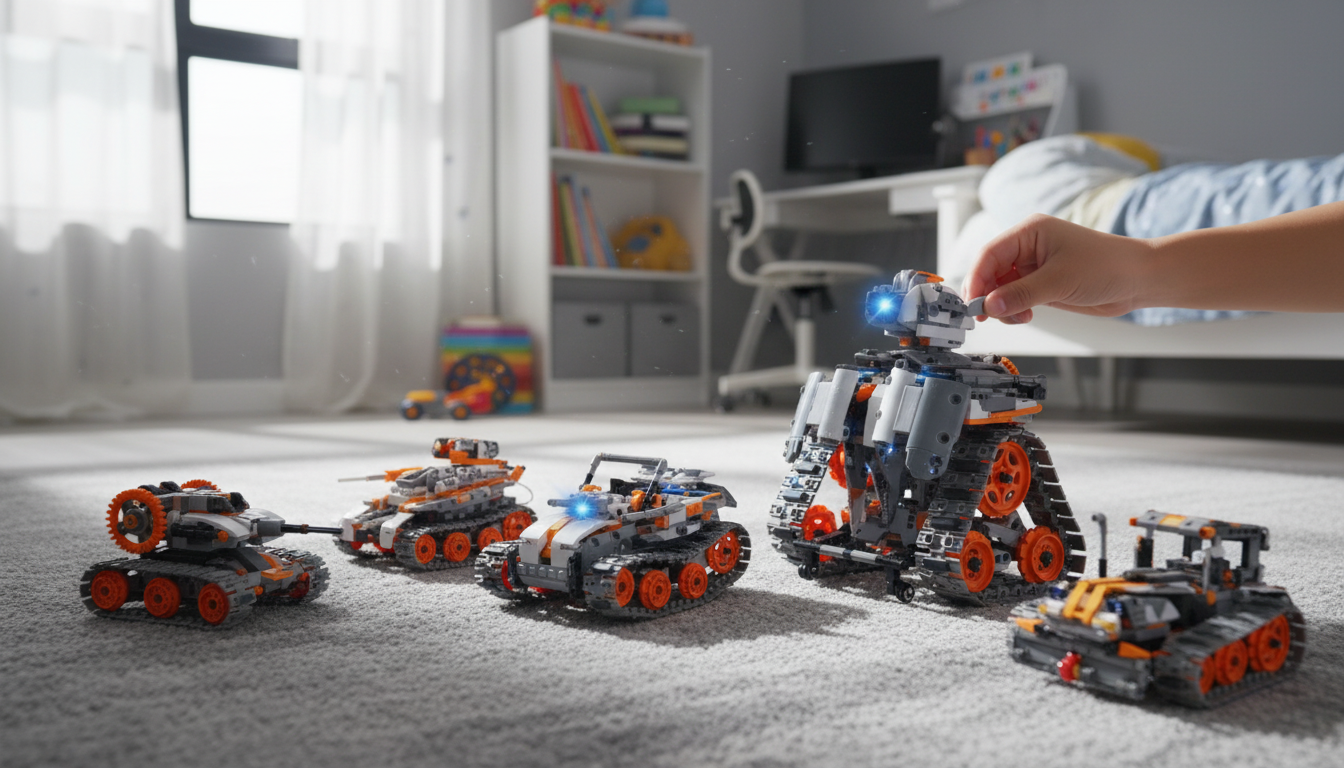
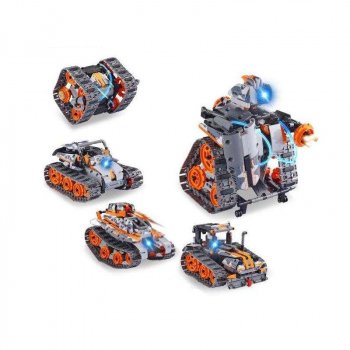
A multi-build RC STEM set combines hands-on construction with remote-controlled play, helping kids practice problem-solving, basic mechanics, and confidence through repeatable builds. This 5-in-1 kit is designed for variety—switching between a robot, tank, snowplow, and additional builds—so the fun continues long after the first model is finished.
Unlike a single-model RC toy, a 5-in-1 building set is meant to be taken apart and rebuilt. That repeat cycle (build, test, tweak, rebuild) encourages kids to learn through iteration instead of aiming for “perfect on the first try.”
That play-driven learning is also well-aligned with how experts describe the role of hands-on play in development. The American Academy of Pediatrics highlights how play supports skill-building and resilience—exactly what kids practice when they test a build, spot a mistake, and try again.
Most 5-in-1 RC STEM sets rely on a core structure that becomes the “base” across models, then swap in different attachments and body shapes to create a new build. The best part: kids start recognizing the repeating logic of a chassis, drivetrain, and structure—then apply it to each new model.
As kids experiment with moving parts and attachments, they’re also encountering practical “simple machine” ideas (like leverage and force) in a hands-on way. For a quick refresher, Encyclopaedia Britannica’s overview of a simple machine connects well to the kinds of mechanisms kids explore during builds.
Each model adds a new challenge, so kids don’t just repeat the same steps. One build might emphasize balance, another stability, and another attachments that interact with objects on the floor.
| Build | Play Style | Skills Reinforced | Quick Build Tip |
|---|---|---|---|
| Robot | Maneuvering, turning, obstacle play | Balance, structural bracing, troubleshooting | Test turning after the first chassis stage |
| Tank | Driving stability, direction control | Alignment, symmetry, mechanical reasoning | Keep left/right assemblies mirrored |
| Snowplow | Pushing light items, role-play tasks | Attachments, leverage basics, iteration | Reinforce the front mount before driving |
| Other models | Variety play, rebuild challenges | Following steps, patience, creativity | Photograph each step if rebuilding later |
Kids feel the “reward loop” quickly: a build works, it drives, it turns, and it can be improved. That cycle makes engineering feel approachable instead of abstract.
For families who want to extend the “why” behind building, NASA’s STEM resources can add extra context and inspiration—especially when kids start asking what real robots do and how engineers test prototypes.
It’s typically best for elementary-age kids and up, especially those who can follow step-by-step instructions with patience. Younger kids can still enjoy it with adult help for sorting parts and building stages, while older kids often rebuild independently and experiment with their own modifications.
Expect the first build to take longer—often 45–90 minutes depending on complexity and how quickly parts are sorted. Rebuilds are usually faster (30–60 minutes) because kids recognize recurring steps and the drive system layout.
Yes, with a few habits: use small trays or resealable bags during disassembly, keep instructions nearby, and do a quick floor-and-table “parts sweep” after each session. Taking a photo of the finished build before taking it apart can also help during reassembly.


Leave a comment
You must be logged in to post a comment.