
Confidence rarely arrives as a sudden personality upgrade; it’s more often built through small, repeatable actions that reshape thoughts, habits, and self-talk. A structured bundle that combines short reads with guided exercises and checklists can make progress feel measurable—especially when motivation is inconsistent or perfectionism gets in the way. This guide breaks down what a 5-in-1 self-confidence bundle typically helps with, who it’s best for, how to use it as a weekly system, and what to look for so the material turns into real-life behavior change.
Self-confidence shows up in moments that require movement without guarantees: speaking up in a meeting, applying for a role you don’t feel 100% ready for, setting a boundary, or trying again after a rough first attempt. It’s less about feeling fearless and more about being willing to act with uncertainty.
It also isn’t the same as constant positivity. Confident people can still feel anxiety, self-doubt, or social awkwardness—especially in new environments. Confidence can coexist with introversion and sensitivity; it simply changes what you do next.
A practical definition that tends to hold up in real life: confidence is trusting your ability to handle outcomes, even if the result isn’t perfect. That trust grows through evidence—small “I did it anyway” reps that slowly weaken avoidance habits.
Common confidence blockers include negative self-talk loops, avoidance patterns, fear of judgment, and all-or-nothing standards. A useful bundle helps you spot which blocker is running the show, then gives you a way to respond in the moment.
One long book can be inspiring and still fail to change behavior—especially when the ideas stay “interesting” rather than practiced. A bundle tends to work better for many people because it makes consistency easier.
For additional science-backed perspectives on resilience and adapting under stress, the American Psychological Association (APA) overview on resilience offers helpful context. For approachable self-help resources, the NHS self-help guides are also a solid reference point.
| Situation | What to read (5–10 min) | What to do (10–20 min) | What to track (1–2 min) |
|---|---|---|---|
| Fear of speaking up at work | Section on assertive communication and thought reframing | Write one clear point, practice a 30-second version, share it once | Did it happen? What was the outcome? What was learned? |
| Avoiding social plans | Section on avoidance cycles and gradual exposure | Create a 3-step exposure ladder; complete step 1 today | Anxiety rating before/after; next step chosen |
| Harsh self-talk after mistakes | Section on self-compassion vs. self-indulgence | Do a 3-question reframe: facts, alternative view, next action | One supportive sentence written and repeated |
| People-pleasing and weak boundaries | Section on values and boundaries | Use a boundary script to say no or propose an alternative | Boundary used? Any guilt? What boundary to try next? |
If anxiety is a major driver, gradual exposure and practical coping tools can help—but severe or impairing anxiety may require professional support. The National Institute of Mental Health (NIMH) overview on anxiety disorders is a reliable starting point for understanding when extra help is warranted.
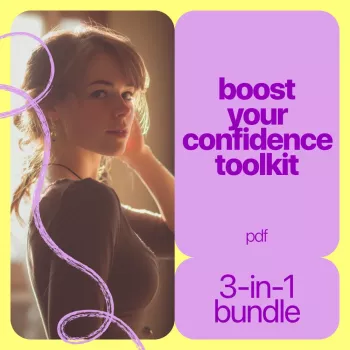
Self-Confidence Transformative Reads: 5-in-1 Bundle of eBooks, Guides & Checklists is designed as a multi-format confidence toolkit: readable lessons paired with guided exercises and quick-reference checklists. It fits a “small daily reps” approach—use one prompt per day, then repeat the same skill in real situations until it feels normal.
If building confidence is part of a broader “reset your environment” season, a couple of practical add-ons can support the routines you’re trying to keep. Consider a calming home upgrade like the Botanical Floral Non-Slip Area Rug – Soft, Modern & Machine Washable for a more inviting daily space, or a comfort-forward option like the Soft Velvet Plush Blue Rug for Living Room & Bedroom – Modern Fluffy Carpet for a cozy corner that makes journaling and reflection easier to stick with.
Small shifts often show up in 1–2 weeks when you do daily micro-actions, because you start collecting proof that you can act even with discomfort. Deeper, more stable confidence typically builds over 6–12 weeks through repeated exposure, reframing, and boundary practice.
Reduce the task to a minimum viable step (two minutes counts), and use the checklists as prompts instead of a “perfect streak” goal. Schedule one repeatable weekly rep and track effort-based wins to rebuild momentum without relying on willpower.
Yes—structured exercises like gradual exposure, thought reframing, and pre-planned scripts can complement anxiety management. If anxiety is severe or significantly impairs daily functioning, professional support can be an important part of the plan.



Leave a comment
You must be logged in to post a comment.