
Car financing paperwork can feel like a maze of numbers, fees, and unfamiliar terms. The good news: most auto loan packets repeat the same core sections, and once you know where the key figures live, the real cost becomes much easier to verify before signing—APR, finance charges, add-ons, payment math, and the rights that protect buyers.
Most dealerships and lenders use a familiar stack of documents, even if the layout looks different from one place to the next. Expect to see:
| Document section | What it controls | What to double-check |
|---|---|---|
| APR & Finance Charge | Cost of borrowing | APR matches what was quoted; finance charge aligns with term and amount financed |
| Amount Financed | Starting principal | No unwanted add-ons included; down payment and trade-in credit applied correctly |
| Total of Payments | Total paid over time | Compare with monthly payment x number of payments; look for odd extras |
| Payment schedule | Due dates and count | First payment date, payment frequency, any balloon payment |
| Fees & charges | Dealer/lender costs passed to buyer | Doc fee, title/registration, taxes; watch duplicates or vague “service” fees |
| Optional products | Add-on contracts | Each item is optional unless required by lender; pricing and cancellation terms |
| Prepayment | Paying early | No prepayment penalty (or confirm if one exists); how payoff is calculated |
APR (Annual Percentage Rate) is designed to express the annualized cost of credit. It’s related to the interest rate, but it can also reflect certain finance charges beyond simple interest. That’s why two loans with the same “rate” can sometimes show different APRs, and why APR is often the best starting point for comparing offers.
If you want a quick benchmark for what must be disclosed and how, Regulation Z (Truth in Lending) is the underlying federal rulebook: Federal Reserve — Truth in Lending (Regulation Z).
Many buyers focus on the monthly payment, but fees and add-ons often decide whether a “good deal” stays good. Watch especially for:
For a consumer-friendly overview of common auto purchase pitfalls, see: Federal Trade Commission — Buying a Car.
For broader guidance on auto loans and shopping for financing, the CFPB’s tools are a reliable reference: Consumer Financial Protection Bureau — Auto Loans.
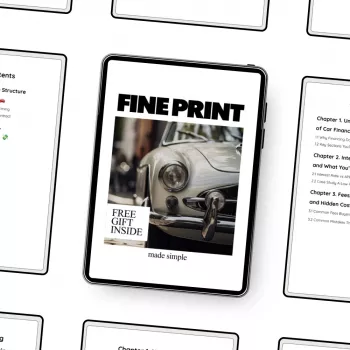
If you want a quick reference you can bring to the finance desk, Fine Print Made Simple | Ebook Guide on How to Read Car Financing Documents, Understand APR, Fees, Loan Terms & Buyer Rights walks through common sections step by step so the numbers and obligations are easier to verify under time pressure.
For a couple of practical extras that can make “paperwork day” easier, consider comfortable, all-day footwear like 2025 Women’s Suede Lace-Up Loafers – Casual Retro Flats for Spring & Autumn, and a clear visual time-check for home budgeting sessions after the purchase, such as the Irregular Beveled Mirror Wall Clock with Roman Numerals – Silent Quartz Movement.
The interest rate is the base cost of borrowing, while APR is a broader annualized measure that can include certain finance charges. APR is usually more useful for comparing two loan offers side by side.
Many add-ons are optional, even if they’re presented alongside required paperwork. If a lender truly requires a specific product, ask for that requirement in writing and request an updated contract reflecting only what’s necessary.
It depends on the prepayment terms in your contract, so look specifically for any prepayment penalty language. Even without a penalty, daily interest can change the payoff amount, so request an official payoff quote before sending final payment.



Leave a comment
You must be logged in to post a comment.