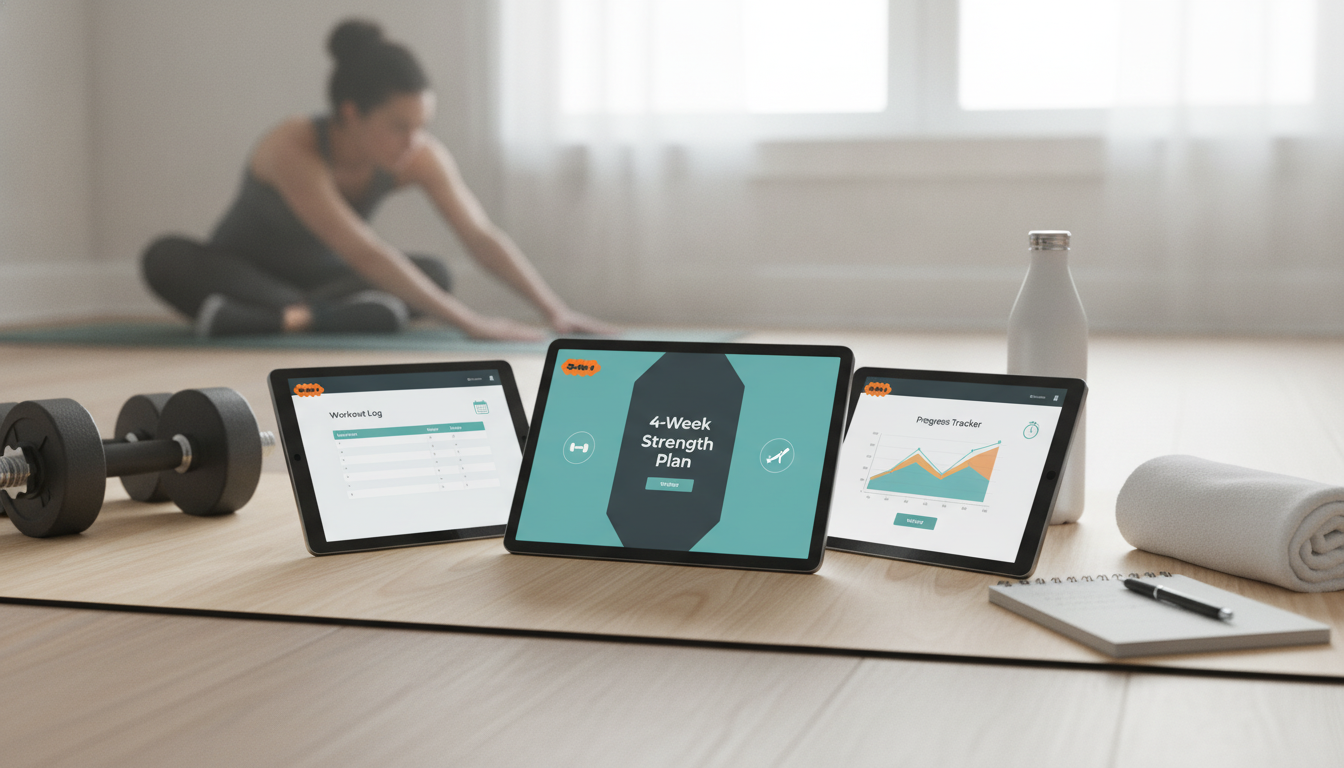
A clear, repeatable plan makes starting strength training far easier than piecing together random workouts. The Free Weight Routine Starter Bundle is a 3-in-1 digital download set built to help you show up consistently, follow structured sessions, progress week to week, and keep your workouts organized—whether you train at home or in a gym.
This starter set combines three coordinated digital resources that work together: a workout structure you can repeat, a weekly scheduling framework, and tracking support to keep your progress visible. It’s designed around free weights—dumbbells, barbells, and kettlebells—with an emphasis on foundational movement patterns (squat, hinge, push, pull, and carry).
Because it’s a downloadable format, you can keep it on your phone or tablet during sessions, or print it if you prefer a clipboard-style setup. The biggest advantage is repeatability: you’ll cycle the same core sessions week after week while gradually increasing load, reps, or sets—without constantly changing exercises and restarting your learning curve.
This bundle is a strong fit for:
If your goal is to build strength fundamentals and develop a routine you can sustain, a structured starter program is often the difference between “sometimes” training and actually stacking weeks of progress.
A smart first month is about quality reps, repeatable effort, and small upgrades over time. Here’s a simple four-week approach that matches how many evidence-based resistance training progressions are taught (see the ACSM guidance on progression models).
Schedule suggestion: Choose either 3 days/week full-body or 4 days/week upper/lower depending on time and recovery. For general health, the CDC recommends strength training at least two days per week, and many people find 3 days/week to be a practical “sweet spot” for skill and consistency.
Record weight, reps, sets, and a quick note on difficulty (easy/steady/hard). That one-word difficulty note makes it easier to decide whether to increase load next time or repeat the same numbers with cleaner reps.
| Progression method | How it works | Best for |
|---|---|---|
| Add reps first | Keep weight the same and add 1 rep per set until hitting the top of a rep range, then increase weight | Learning form and building consistency |
| Add weight in small steps | Increase load by the smallest available increment when all sets are completed with good technique | Main compound lifts and steady strength gains |
| Add a set | Maintain weight and reps but add one extra set on key lifts for more weekly volume | Plateau breaking when recovery is good |
| Deload every 4–6 weeks | Reduce volume (sets) and/or intensity (load) briefly to recover and keep progressing | Avoiding burnout and nagging aches |
You don’t need a full gym to start training effectively.
If a movement feels uncomfortable, swap to a similar pattern rather than forcing it. Examples:
Good training is rarely about going to the limit—it’s about doing quality work you can recover from. For reliable basics and safety reminders, the NSCA training education resources are a solid reference point.
If you want a structured, repeatable routine you can start immediately, the Free Weight Routine Starter Bundle – 3-in-1 Digital Download Set for Strength Training is available as a convenient digital download.
Most beginners do well with 2–4 days per week depending on schedule and recovery, with 3 days/week full-body being a practical default. Consistency matters more than squeezing in extra days early on.
Free weight training builds strength and supports muscle gain, while fat loss depends primarily on overall calorie balance. When paired with consistent workouts and adequate protein, many people see noticeable body composition improvements over time.
Use rep targets and form as your guide: pick a load that leaves about 1–3 reps in reserve on most sets. Adjust by the smallest increment available and track changes week to week so progress stays controlled.




Leave a comment
You must be logged in to post a comment.