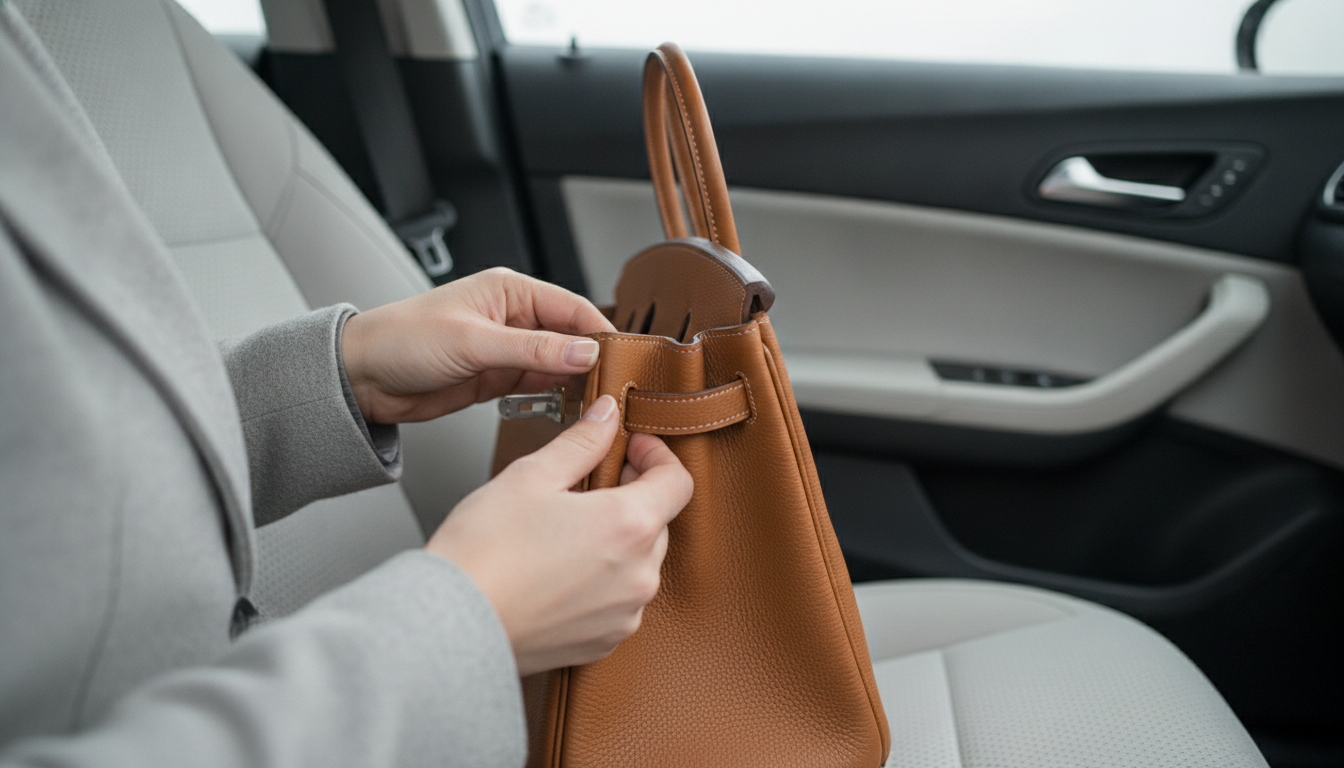
On an authentic Hermès Birkin, the “serial number” most shoppers mean is the blind stamp (also called the date/atelier stamp). It isn’t printed on a tag or label. Instead, it’s discreetly heat-stamped into the leather, and its placement can vary by year and style.
Start by looking inside the bag near the top edge. Many Birkins have the blind stamp on the inside of the front flap area, close to where the sangles (the leather straps) rest. It may be slightly hidden by the way the flap folds, so use bright light and gently angle the leather rather than forcing it.
Next, check near the interior side panel close to the zipper area (if your Birkin has an interior zip pocket). Depending on the production period, stamps can appear on an interior leather tab, near a seam, or tucked into a less-visible corner. The stamp can be faint—especially on grained leathers—so a flashlight and a slow scan help.
Hermès blind stamps are typically a small set of characters (often a letter and sometimes a symbol) that correspond to the production year, along with craftsman/atelier markings. The impression is clean and precise, not overly deep or ragged. If you’re seeing something that looks printed, unusually large, or placed on a fabric lining label, that’s a red flag.
Avoid scraping with fingernails, using liquids, or bending the flap aggressively to “make the stamp appear.” If the imprint is very light, use angled lighting and patience rather than pressure.
Blind stamps are only one part of confirming a Birkin. For a broader, methodical inspection (hardware, stitching, embossing, and more), follow this guide: Hermès brand check routine to authenticate Birkins (step-by-step).
Most authentic Birkins have a blind stamp, but its format and placement can vary by year and production details. Some stamps are extremely faint, especially on certain leathers or colors, so careful lighting is important.




Leave a comment
You must be logged in to post a comment.