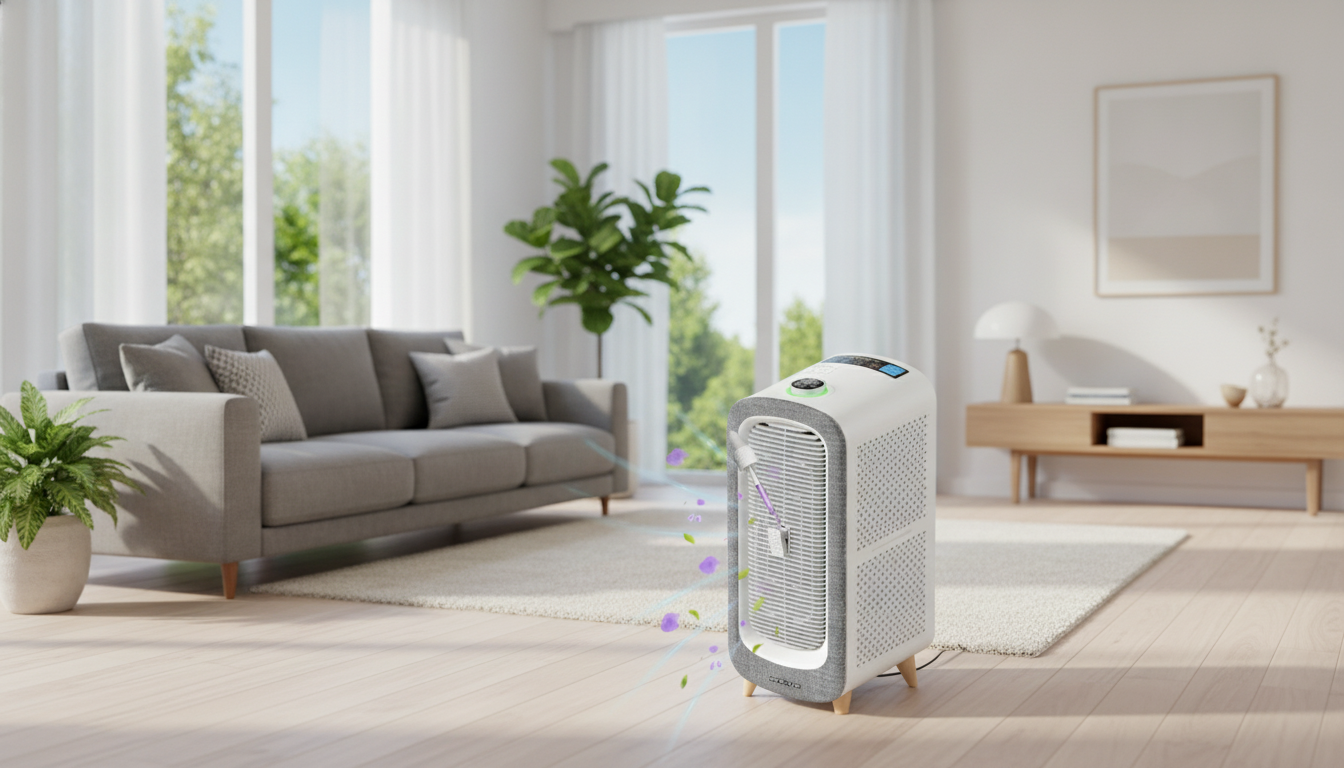
Large open layouts, high ceilings, and busy households can overwhelm smaller air cleaners. A high-capacity purifier with a true HEPA filter can help reduce airborne dust, pollen, smoke particles, and other fine debris while keeping airflow strong enough for wide rooms. For families managing allergy seasons, pet shedding, or periodic smoke and cooking haze, choosing a purifier that can keep up with the volume of air in a big room is what turns “running” into “working.”
Big rooms don’t just have more floor space—they have more air volume, more mixing, and more places for particles to linger.
HEPA 13 filtration is designed for fine particle capture, which is why it’s often chosen for households dealing with dust, pollen, and smoke particulate. Still, it helps to separate particle cleanup from odor control.
For more background on home air cleaning and common limitations, the EPA’s guidance is a helpful reference: U.S. Environmental Protection Agency (EPA) — Guide to Air Cleaners in the Home.
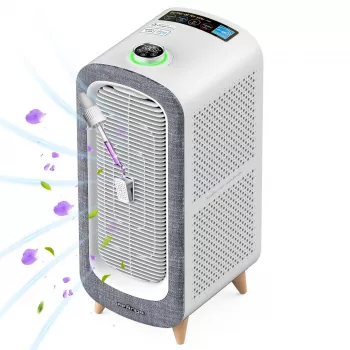
When the goal is treating a truly large living area—like a combined living room and kitchen, a loft, or a finished basement—capacity and consistent operation matter. The Air Purifier for Home Large Room Up to 2105ft² with HEPA 13 Filters is built for large-area use and targets fine airborne particles that contribute to dust buildup and allergy discomfort.
| Room/Scenario | Recommended Approach | Placement Tip |
|---|---|---|
| Open-plan living + kitchen | Run at higher speed during cooking and for 30–60 minutes after | Keep airflow path clear; avoid pointing exhaust directly at curtains |
| Large bedroom (allergy season) | Continuous low/medium speed overnight | Place 6–10 ft from the bed, away from bedding and walls |
| Basement or rec room | Long runtime; pair with humidity control if damp | Position away from corners to reduce dead zones |
| Wildfire smoke days | Close windows/doors; run at high speed for faster particle reduction | Centralize unit to cover connected spaces |
Square footage ratings are a starting point, but real homes have variables that affect how quickly particles drop.
If you’re comparing models, AHAM’s overview of Clean Air Delivery Rate (CADR) can help explain why airflow and particle delivery matter in practice: Association of Home Appliance Manufacturers (AHAM) — CADR Overview.
For broader indoor air quality planning (especially during smoke events), ventilation guidance is also useful alongside filtration: CDC — Ventilation and Indoor Air Quality.
Most households land in a practical range of about 6–12 months, but pets, wildfire smoke, and renovation dust can shorten that window. If airflow seems weaker or particles linger longer than usual, the filter may be loaded—follow the unit’s replacement indicator or recommended schedule for the most reliable performance.
HEPA 13 filters primarily remove particles, not gases, so odors usually require activated carbon or other odor-adsorbing media. For strong smells, pairing filtration with ventilation and source control (like kitchen exhaust and prompt cleanup) makes a noticeable difference.
Choose a spot with unobstructed airflow—often near a central, high-traffic area or along a clear wall—with several feet of clearance from walls, curtains, and large furniture. Keep doors open if you want to treat connected spaces, or close them to focus cleaning power in one room.

Leave a comment
You must be logged in to post a comment.